
Do Men and Women Want Different Things from Cosmetic Dentistry?
When people think about cosmetic dentistry, they often focus on the procedures—veneers, whitening, dental implants, or smile makeovers. But one of the most important questions is rarely discussed:
What does the patient actually want their smile to say about them?
The answer is not always the same. While every patient is unique and should never be placed into a category, decades of clinical experience and research have shown that men and women often have different priorities when it comes to cosmetic dentistry. Understanding these differences helps create smiles that look authentic, natural, and harmonious with the individual rather than simply attractive by a universal standard.
The goal of cosmetic dentistry should never be to give every patient the same smile. The goal is to design the right smile for the right person.

Every Smile Should Be Personalized
Age, facial structure, personality, occupation, lifestyle, and personal preferences all influence smile design. Gender is simply one of many factors that an experienced cosmetic dentist considers during treatment planning.
Some patients want a dramatic transformation that brightens their entire appearance. Others want improvements so subtle that friends notice they look healthier without realizing they had dentistry performed.
Listening to the patient’s goals is often just as important as evaluating their teeth.
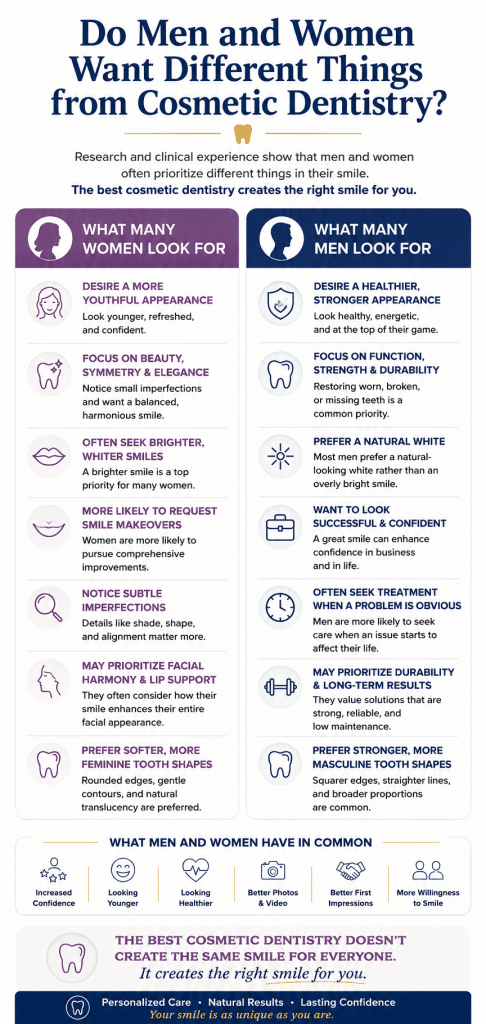
What Many Women Look for in Cosmetic Dentistry
Although every patient is different, women often place greater emphasis on aesthetics and facial harmony.
Many women seek treatment because they want to:
- Look younger
- Create a brighter smile
- Improve tooth symmetry
- Close small spaces
- Restore worn or chipped edges
- Enhance overall facial balance
- Feel more confident when smiling in photographs or videos
Women frequently notice subtle details that many people overlook. Slight differences in tooth length, minor rotations, uneven gum lines, or discoloration may become significant concerns because they affect how the overall smile appears.
In smile design, many women also prefer teeth with softer contours, gentle line angles, and naturally youthful characteristics. The objective is usually elegance rather than exaggeration.
What Many Men Look for
Men often approach cosmetic dentistry from a different perspective.
Many are motivated by concerns such as:
- Worn or broken teeth
- Missing teeth
- Difficulty chewing
- Looking healthier
- Appearing more energetic
- Increasing confidence in professional settings
One statement heard frequently from male patients is:
“I don’t want anyone to know I had cosmetic dentistry.”
Rather than seeking a dramatic cosmetic change, many men simply want to look like a healthier version of themselves.
When designing smiles for male patients, dentists often preserve stronger tooth proportions, slightly squarer tooth shapes, and natural color characteristics. The result should appear confident and healthy without looking artificial.
Smile Design Is About More Than White Teeth
Many people assume cosmetic dentistry is simply about making teeth whiter.
In reality, successful smile design considers dozens of factors, including:
- Tooth shape
- Tooth proportions
- Smile width
- Lip support
- Facial symmetry
- Gum display
- Bite relationship
- Age
- Skin tone
- Facial profile
- Personality
These elements work together to create a smile that complements the entire face.
An experienced cosmetic dentist evaluates these relationships rather than selecting a standard shade or copying another person’s smile.
Confidence Is the Common Goal
Although men and women often emphasize different priorities, they usually share the same underlying motivation.
Patients commonly hope to:
- Smile without hesitation
- Feel younger
- Improve self-confidence
- Look healthier
- Make better first impressions
- Feel comfortable in photographs and video calls
- Enjoy social interactions more freely
Cosmetic dentistry is rarely just about teeth.
It is often about how patients feel every time they smile.
The Growing Number of Men Seeking Cosmetic Dentistry
One noticeable trend over the past two decades has been the increasing number of men pursuing cosmetic dental treatment.
Professional appearance, video conferencing, social media, and longer careers have all contributed to this shift.
Many male patients who once viewed cosmetic dentistry as unnecessary now recognize that a healthy, attractive smile projects confidence, vitality, and professionalism.
Today’s cosmetic dentistry is also much more conservative than many people realize. Modern materials and techniques allow dentists to preserve more natural tooth structure while creating results that are remarkably lifelike.
Communication Is the Most Important Step
Perhaps the greatest difference between successful and unsuccessful cosmetic dentistry is communication.
Before recommending treatment, an experienced cosmetic dentist should ask questions such as:
- What do you like about your smile?
- What would you most like to improve?
- Do you want a dramatic change or a subtle enhancement?
- Are there smiles you admire?
- What concerns you most?
These conversations help establish realistic expectations and guide treatment toward results that reflect the patient’s own vision.
The most beautiful smile in the world is not successful if it does not feel like the patient’s smile.
There Is No “Male Smile” or “Female Smile”
While trends certainly exist, there is no universal male smile and no universal female smile.
Some women prefer stronger, more angular tooth shapes. Some men prefer softer, more youthful aesthetics. Individual personality always outweighs stereotypes.
The best cosmetic dentists avoid creating identical smiles for every patient. Instead, they design smiles that complement facial features, preserve individuality, and respect each patient’s personal preferences.
The Bottom Line
Cosmetic dentistry is both a science and an art.
Science provides the knowledge of bite, function, materials, and long-term stability. Art determines how those principles are applied to create a smile that appears natural and enhances the patient’s overall appearance.
Whether the goal is a subtle refinement or a complete smile transformation, successful cosmetic dentistry begins by understanding the person—not just the teeth.
At The Kurpis Center for Implant & Cosmetic Dentistry, every smile is individually designed to complement the patient’s facial features, age, personality, and goals. Rather than creating the same smile for everyone, treatment is customized to achieve a result that looks natural, functions comfortably, and reflects who the patient truly is.
Because in the end, the most successful cosmetic dentistry is not about creating someone else’s smile.
It is about creating the smile that is uniquely yours.