
Full Mouth Reconstruction: What Happens If I Wait?
One of the most common questions people ask after learning they may need a full mouth reconstruction is:
“What happens if I wait?”
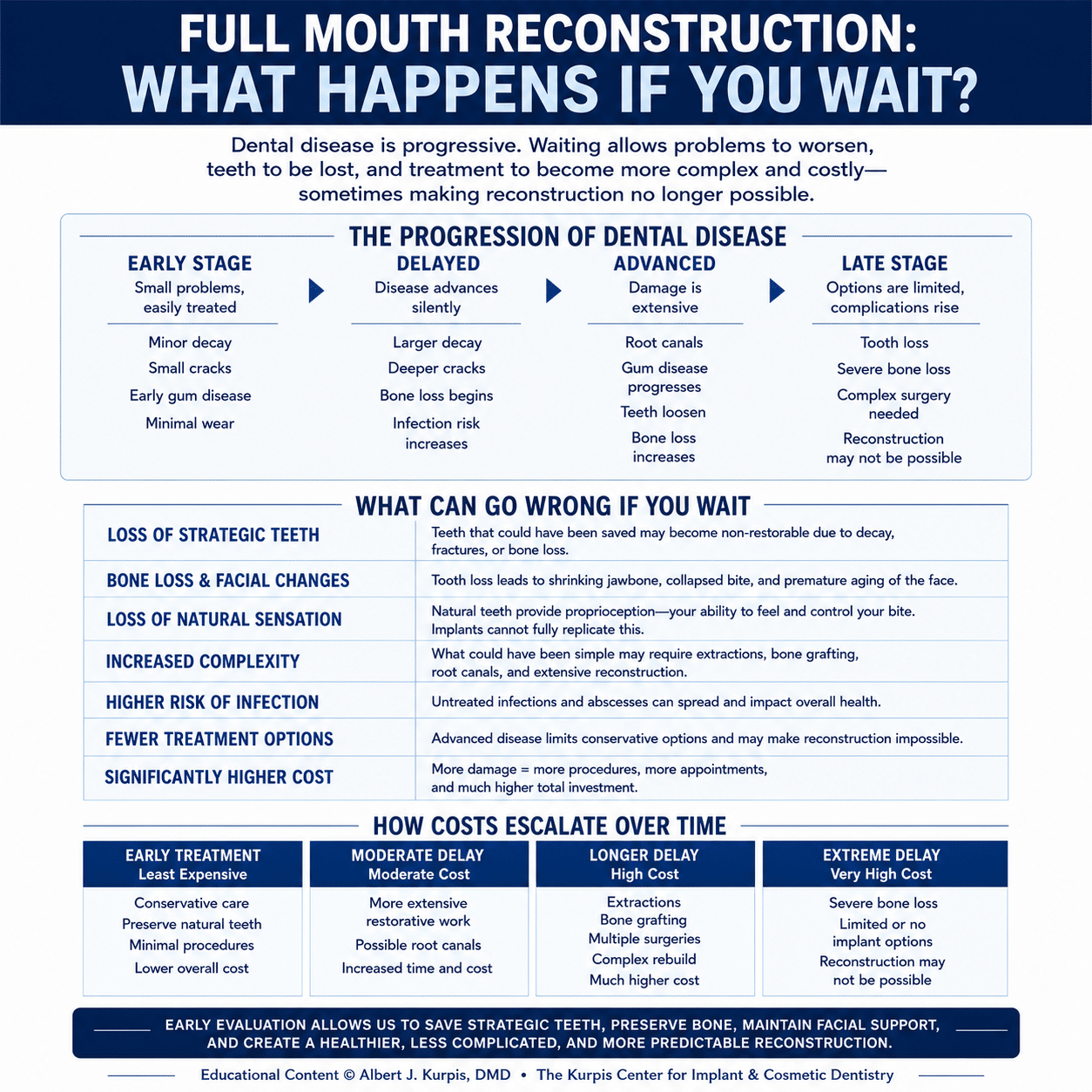
It is a fair question. Full mouth reconstruction is a significant decision, and many people understandably need time to think about it. However, what many patients do not realize is that most of the dental problems leading to full mouth reconstruction are progressive—not static.
Unlike a broken bone that heals or a cut that closes, damaged teeth, advanced gum disease, fractured restorations, and bite collapse generally continue to worsen over time. Waiting often means fewer treatment options, higher costs, and the permanent loss of teeth that might have been saved if treated earlier.
Disease Rarely Stands Still
The mouth is constantly functioning. Every day you chew, swallow, clench, grind, and expose your teeth to bacteria and acids. Even if you are not experiencing significant pain, disease may still be progressing.
Common conditions that continue to worsen include:
- Large cavities
- Cracked or fractured teeth
- Advanced tooth wear
- Gum (periodontal) disease
- Chronic dental infections
- Bite collapse
- Loose teeth
- Failing crowns and bridges
The longer these problems remain untreated, the more complicated they often become.
The Opportunity to Save Strategic Teeth May Be Lost
One of the most important goals during full mouth reconstruction is determining which natural teeth can realistically and predictably be preserved.
Whenever possible, preserving healthy strategic teeth offers significant long-term advantages.
Strategic teeth can:
- Help support bridges or restorative treatment
- Preserve important jawbone
- Maintain facial support
- Help retain natural chewing function
- Improve overall treatment flexibility
Unfortunately, delaying treatment can allow these valuable teeth to deteriorate beyond the point where predictable treatment is possible.
A tooth that might have been saved today could become non-restorable six months or a year later because of:
- Progressive decay
- Root fracture
- Severe periodontal bone loss
- Untreatable infection
- Extensive structural breakdown
Once that opportunity is gone, it cannot be regained.
Bone Loss Changes the Face
Many people think teeth exist simply for chewing.
In reality, they also preserve the bone that supports the face.
The roots of natural teeth continually stimulate the surrounding alveolar bone. This stimulation helps maintain the height and width of the jaw.
When teeth are lost, that stimulation disappears.
Over time the jawbone begins to shrink.
This can contribute to:
- A collapsed bite
- Sunken facial appearance
- Less lip support
- Increased facial wrinkles
- Premature aging around the mouth
- Reduced facial muscle support
Whenever strategically appropriate, preserving natural teeth can help maintain these important facial structures.

Natural Teeth Provide Something Implants Cannot
Modern dental implants are one of the greatest advances in dentistry and can replace missing teeth extremely well.
However, implants cannot completely replace one remarkable feature of natural teeth.
Proprioception
Natural teeth are connected to the jawbone by a tiny ligament called the periodontal ligament.
Within this ligament are thousands of specialized nerve endings that constantly communicate with your brain.
This system is known as proprioception.
It allows you to:
- Feel even tiny particles between your teeth
- Sense chewing pressure
- Detect when your bite feels “off”
- Control chewing forces automatically
- Protect teeth from excessive loading
Most people have experienced this without realizing it.
Even a tiny popcorn hull or a strand of hair between two teeth can feel enormous because your natural teeth are incredibly sensitive.
Dental implants do not contain a periodontal ligament.
While the surrounding tissues and jaw muscles provide some sensory feedback, implants cannot fully reproduce the refined tactile sensation of natural teeth.
For this reason, when a natural tooth has a predictable long-term prognosis, preserving it may provide benefits that no artificial replacement can completely duplicate.
Small Problems Become Bigger Problems
Dental disease often progresses quietly.
A small cavity may eventually require:
- A filling
- Then a crown
- Then a root canal
- Then crown replacement
- Then extraction
- Finally an implant or bridge
Similarly, untreated gum disease gradually destroys the bone supporting the teeth.
As more bone is lost:
- Teeth loosen
- Bite forces become less stable
- Infection progresses
- Additional teeth become affected
The longer treatment is postponed, the fewer conservative options often remain.
Treatment Usually Becomes More Complex
When reconstruction is delayed, additional procedures may become necessary.
These can include:
- Tooth extractions
- Bone grafting
- Sinus augmentation
- Multiple root canals
- Periodontal surgery
- Orthodontic correction
- More extensive implant reconstruction
Treating problems earlier often allows for simpler, less invasive treatment.
Waiting Usually Increases the Cost
Many patients postpone treatment because they hope to avoid the financial investment.
Ironically, delaying care frequently results in significantly greater expense.
Why?
Because the disease continues to progress.
As additional teeth fail, treatment becomes more involved.
More appointments.
More procedures.
More restorative work.
More surgical intervention.
Earlier treatment often preserves more natural teeth while reducing the overall complexity of reconstruction.
Pain Is Not a Reliable Guide
One of the biggest misconceptions is:
“If it doesn’t hurt, it can’t be that bad.”
Unfortunately, many serious dental conditions produce very little discomfort until extensive damage has already occurred.
Advanced periodontal disease is often called the “silent disease” because significant bone destruction can occur with surprisingly little pain.
Likewise, chronic infections may remain relatively comfortable until they suddenly become acute.
Waiting for pain is rarely the best indicator of when treatment should begin.
Every Patient Is Different
Not everyone who is advised to undergo full mouth reconstruction requires immediate treatment.
Some patients can safely monitor certain conditions.
Others require prompt intervention to preserve teeth and bone.
The key is obtaining a comprehensive diagnosis that evaluates:
- Which teeth can realistically be saved
- Which teeth cannot be predictably maintained
- The health of the supporting bone
- Bite stability
- Gum health
- Long-term prognosis
Only then can an informed decision be made.
The Bottom Line
One of the greatest advantages of early evaluation is not necessarily beginning treatment immediately.
It is understanding what options still exist today before those options disappear tomorrow.
When strategic teeth can be preserved, they often help maintain jawbone, facial support, natural sensation, and chewing function while simplifying reconstruction.
The longer advanced dental disease progresses, the greater the chance that these opportunities will be permanently lost.
If you have been told you may need full mouth reconstruction—or if you are wondering whether your teeth can still be saved—the most valuable step is obtaining a thorough examination before time removes treatment options that may no longer be available later.
In many cases, the best investment is not simply replacing what has already been lost. It is preserving what can still be saved.