< Previous | Contents | Next >
TRY BEFORE YOU BUY - WHAT WILL MY SMILE LOOK LIKE?
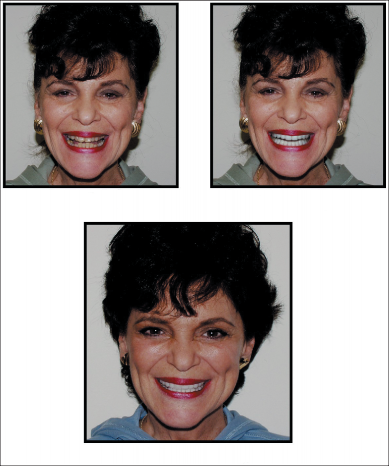
Before
Simulation
Actual Results
any times the anticipated change in one’s smile may create a level of anxiety for the patient. At the same time, the expectations of the patient may be unclearly defined, creating concern for the cosmetic dentist.
They both need to know in a very general way, what the final result will look like. Unfortunately, many smile makeover proce- dures with ceramic material, especially porcelain veneers, cannot be temporarily placed in the mouth on a trial basis. Once they are made in the lab, and verified in the mouth, they must be permanently cemented. There is no way to temporarily cement the thin ceramic material to the prepared tooth without it breaking or immedi- ately falling off.
Sometimes, an approximate preview of the final result is necessary before the smile makeover can proceed.
There are three options to preview a smile, all having certain limitations. The first is called cosmetic imaging. Your cosmetic dentist can take a pre-operative digital photograph of your smile
and perform cosmetic imaging on a computer, to simulate how your new smile might look. (figure 59)
The nice thing about imaging is that it is quick and easy for the cosmetic dentist to do. If
figure 59
TRY BEFORE YOU BUY - WHAT WILL MY SMILE LOOK LIKE?TRY BEFORE YOU BUY

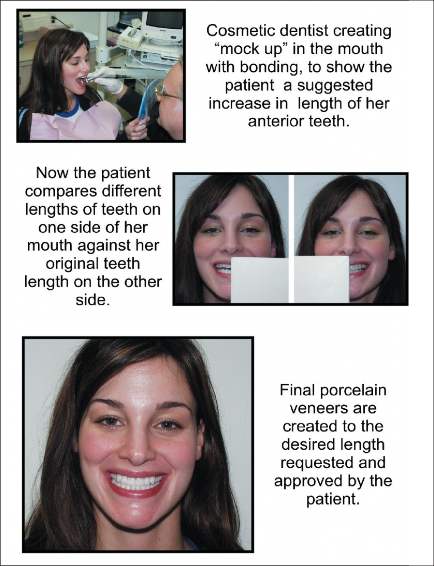
figure 60
you don’t like something, just change it. Teeth can be made to look longer, shorter, wider or whiter to name just a few variations. Unfortunately, you can do things on the comput- er that cannot actually be reproduced in the mouth. That is why many cosmetic imaging pre- view pictures look different than the final results. Cosmetic imaging on a computer can be used as a practical guide as long as the patient under- stands that the final results may and do vary.
A second alternative way to preview a smile is called a mock-up, made with composite bonding materials. With a mock-up, composite bonding materials are applied onto the unpre- pared teeth. Possible changes in the mouth are created for the patient to see. The cosmetic pro- cedures are limited by the fact that no tooth struc- ture is removed. The result may appear “bulkier” than the final result. As long as the patient under- stands this fact, the technique has a lot of merit. Another limitation is the cosmetic dentist. He/she may not have the artistic ability to create the desired result with composite that the patient may be looking for. If the individual dentist lacks this tal- ent or ability this technique should not be used. They should rely on the talent of their ceramist to create the final result.
When the mock-up guide is acceptable to the patient, an impression of it is taken and a duplicate stone cast made, which is then sent to the ceramist. This will be used as a guide for the final restoration. This technique is particularly useful when teeth are to be made larger or longer or the arch form needs to be built out for a wider smile appearance. (figure 60).
CHAPTER FIVE

Sometimes the bite relationship must be changed to achieve an acceptable cosmetic result.
This is particularly true when the bite must be opened to correct a cross bite situation (when the maxillary teeth are inside upon closing instead of overlapping outside the mandibular teeth). For this situation a laboratory can fabricate a tempo- rary set of plastic like teeth with an open bite, called “snap on smile”. This can be worn by the
patient for a short period of time to see if they can tolerate the bite alteration. The advantage of the snap on smile is that it is removable. It can be brought home to show other people who might influence a patient’s decisions about changing their smile. This technique can be used as a guide when considering major changes to a smile. It can also be used when a patient needs a period of time to adjust to the new look. (fig. 61)
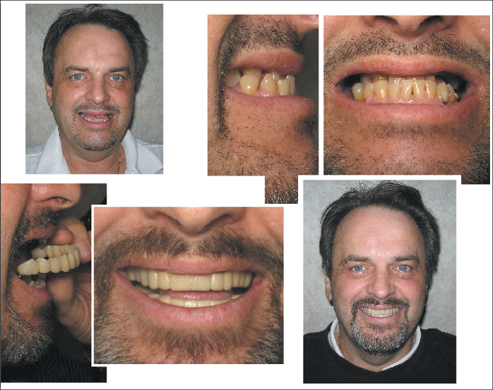
figure 61
CHAPTER SIX
This chapter from Amazing Smiles Through Cosmetic Dentistry explains or demonstrates try before you buy - what will my smile look like? as part of Dr. Albert J. Kurpis’s broader cosmetic dentistry approach to improving smile balance, appearance, and confidence.
The right treatment depends on the condition of the teeth, gums, bite, facial balance, smile goals, and a professional examination. Similar-looking smile problems may require different solutions.
Cosmetic dentistry is designed to improve the appearance of the teeth and smile. For many patients, a more balanced and attractive smile can also improve confidence in social, personal, and professional situations.
Use the related chapter links on this page to explore similar cosmetic dentistry cases, porcelain veneer examples, dental implant topics, bite correction cases, and full mouth reconstruction chapters.
Swipe left or right on mobile to move between book pages.