< Previous | Contents | Next >
COSMETIC DENTAL PROCEDURES
V
arious dental materials are used during cosmetic dental procedures to restore and replace teeth. These materials, along with the way they are used, have a profound effect on the way a smile ultimately looks. When dentists started using a material know as cos-
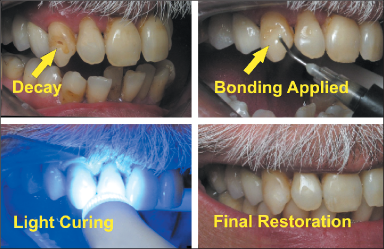
metic resins, more commonly know as bonding, the first dramatic cosmetic changes were seen. This material brought modern cosmetic dentistry into the forefront of today’s dental care. Bonding is used in a putty or liquid form to cover, repair, extend or replace tooth surfaces. (figure27)
The tooth receiving the bonding material is etched with a mild acid, making it more porous. The bonding composite resin is applied, fused and hardened with a light gun. Finally, the bonded material is shaped, adjusted and polished. Bonded composite resins are excellent material for filling small caries (cavities), and for repairs at the gum line. Bonding can also close small gaps between teeth. However, it does not hold up well when used to fill large holes on biting surfaces or on the incisal edges of teeth.
The first real public awareness of modern cosmetic dentistry occurred when cosmetic dentists began performing complete smile makeovers. These early pioneers in cosmetic dentistry
figure 27
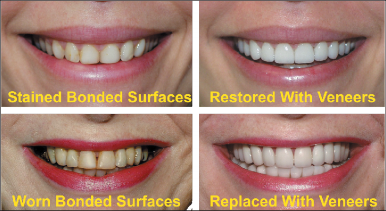
figure 28
Cosmetic Dental Procedures
figure 29
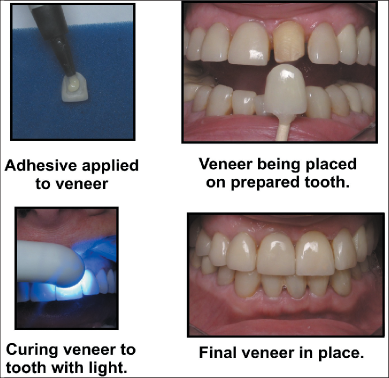
figure 30
changed or replaced the entire outer surfaces of the anterior teeth with bonded composite resins. This changed the way teeth looked when the patient smiled. Although the results were dramat- ic, many times the bonded material for full smile makeovers did not withstand the test of time. Often, the bonded surfaces would break or wear down. Other times, they would absorb stains which lead to discoloration. (figure 28)
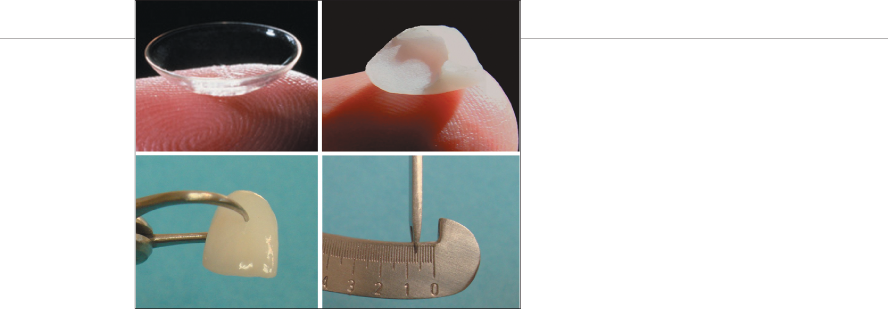
A stronger and more permanent material had to be developed; hence the porcelain veneer was created. Porcelain veneers are very thin pieces of porcelain (they can be made as thin as a contact lens), which fit directly over the outside of existing teeth. (figure 29). They are permanently fused to existing tooth structure with a liquefied bonding adhesive which is cured by a special curing light. (figure 30).
In order to avoid creating teeth that look too bulky, (caused by layering too much material on top of the teeth), a small amount of tooth struc- ture must be removed. Doing so makes the final result look and feel more natural.
There is much publicity about drill less thin veneers today. However, experience shows that this application has limitations. Most patients requiring porcelain veneers need some tooth reduction to obtain a natural and realistic result.
When teeth do not have enough natural tooth structure to support a porcelain veneer, a crown (cap) must be fabricated. The entire tooth surface
CHAPTER THREE

must be removed with a dental drill so that a full tooth covering can be made. (figure 31)
There are several techniques for fabricating crowns. One type of crown has a metallic core which is covered by a thin layer of porcelain. It is held in place by dental cement. This is called a “porcelain fused to metal crown.” (figure 31b). When the inner core is gold, it is called a “porce- lain fused to gold crown.” When porcelain fused to metal or gold crowns are used, the metal inside the crown must be covered with an opaque layer. To prevent the metal color from showing through the translucent porcelain. However, opaque lay- ers affect the color quality of these types of crowns. They often look too harsh or “dead” because of their poor reflective qualities and lack of translucency. This effect can be important by using a high carat alloy gold inside the crown. In addition careful staining by a very talented dental technician can sometimes overcome this opaque look to make the crown look more natural. However, this is not an easy task and it truly involves a great deal of talent and experience.
If the crown cannot be seen when smiling, it can be made entirely of metal, such as gold. However, for the purpose of this book, we will concentrate on cosmetically visible crowns, as their esthetic requirements are different.
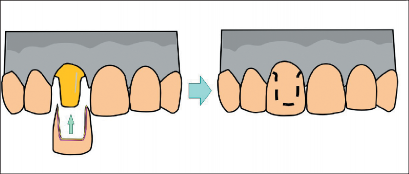
figure 31
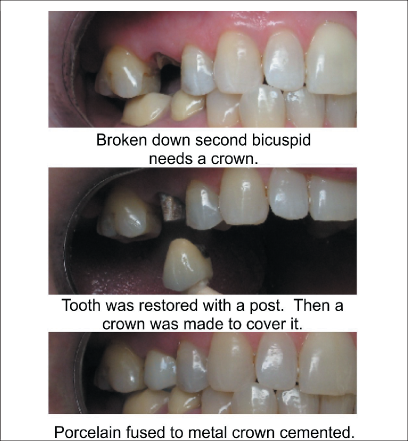
figure 31b
Cosmetic Dental Procedures

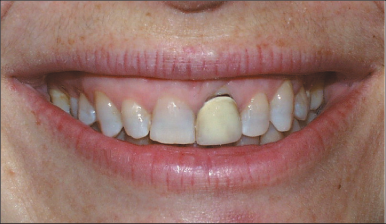
figure 32
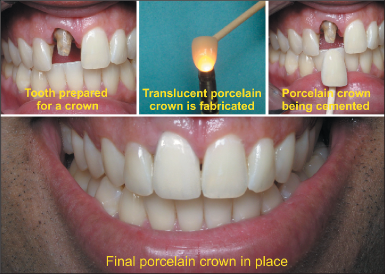
figure 33
Another problem associated with porcelain fused to metal crowns is the black line phenomenon. (figure 32). The black line appears because the porcelain fused to metal crown must end at or below the gum line with an all-metal margin. Dentists usually try to hide this black line by preparing the tooth deep enough below the gum line so that the metal margin does not show. However, many patient’s gums are thin and translucent and the dark line shows through. Some have gum recession over time, exposing the black line of the metal margin, which original- ly did not show. The “black line” phenomenon is eliminated when using a “all porcelain crown.” (figure 33).
The greatest advantage of all porcelain crowns is that they look more natural in the mouth. This is due to the fact that, similar to a natural tooth, light transmits through the porce- lain.
CHAPTER THREE

As mentioned earlier, bonded, composite restorations were the first cosmetic restorations performed in modern cosmetic dentistry. They are routinely used to add contour to teeth to correct small spaces, or to fill small cavities caused by decay. Sometimes, the hole left in the tooth by decay is very large. Other times, large, dark, gray, old silver fillings must be replaced. The resulting holes left on these teeth are much too large for bonded, composite restorations. The bonded, composite restorations are simply not strong enough to withstand the chewing forces to which the teeth will be subjected. Yet there is enough healthy tooth structure left so that a full crown does not have to be placed on the tooth. The restoration of choice for this situation is the “inlay.”
Originally, inlays were fabricated from solid gold. However, our cosmetically conscious society demanded more attractive restorations. The result was the development of the composite inlay, the porcelain inlay, and porcelain-fused-to-gold inlay. Porcelain inlays although attractive have a high fracture rate. Composite inlays are more resilient and are commonly used today. They are fabricated in the dental lab out of a very esthetic tooth-colored material. Once sent back to the dentist they are permanently cemented into large cavities pre- pared in teeth, providing strong and lifelike restorations that can last several decades. (figure 34)
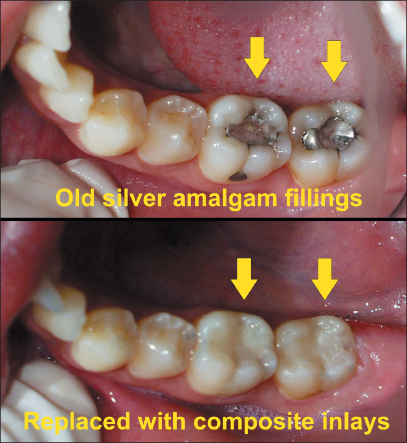
figure 34
Cosmetic Dental Procedures
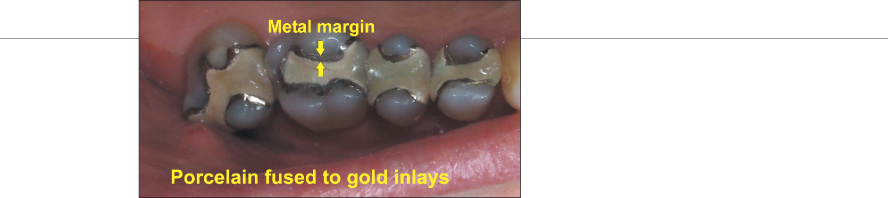
figure 35
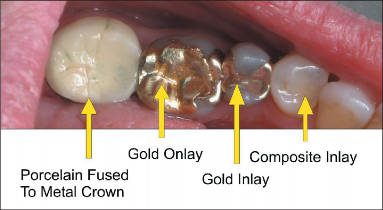
figure 35b
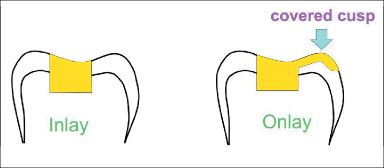
figure 36
A much stronger and more enduring restoration is the “porcelain-fused-to-gold” inlay. (figure 35). These inlays have the advantage of the strength of metal with the aesthetic covering of porcelain. However, the aesthetics are compro- mised because the tiny metal margin can be seen, and the opaque liner on top of the metal distorts the shade of the porcelain. These restorations are most suitable for the back part of the mouth, where they often do not compromise your smile.
If you can’t see the restoration at all when you smile, the gold inlay is still the standard by which all filling materials are compared. (figure 35b). Gold inlays, when properly made, can last the lifetime of the patient, provided the patient maintains their mouth properly. As new porcelain technology develops and more durable cements are created, porcelain inlays may approach the gold inlay for long lasting durability and function. One final note, if an inlay is large enough to cover a cusp of a tooth, ( the bumps on top of teeth), it is referred to as an onlay rather than an inlay. (figure 36)
The greatest cosmetic challenge occurs when teeth are missing from the mouth. When one or more teeth are missing, there are several options to consider. These options range from removable appliances called dentures or partial dentures, to fixed bridges, to dental implants.
CHAPTER THREE
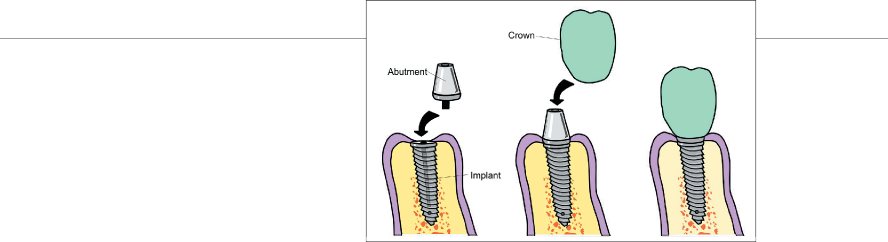
If there is sufficient bone where a tooth is missing, a dental implant is the restoration of choice. (figure 37). Dental implants are metallic cylinders (like a wide screw) that are placed direct- ly into the bone where the lost tooth root once was. The implant fuses to the surrounding bone by a process called osseointegration. This process can take from four to six months. When the implant finally osseointegrates, a post (called an abutment) is placed into the dental implant. A crown is then placed on top of the implant, per- manently replacing the missing tooth (figure 38)
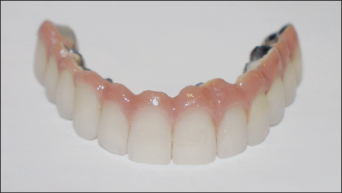
figure 38b
figure 37
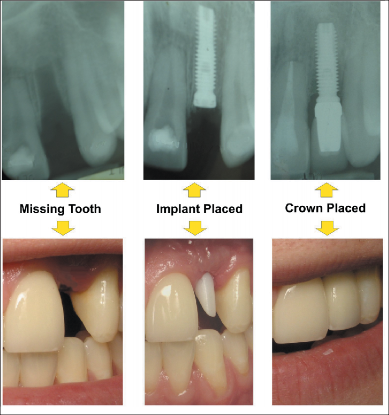
figure 38
Cosmetic Dental Procedures

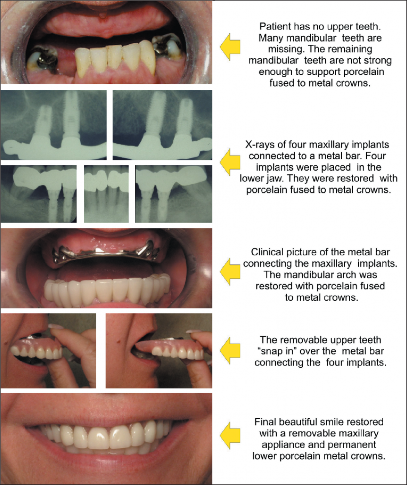
figure 39
When all teeth are missing in one arch, the patient may choose to have them replaced with multiple dental implants. There are many ways to restore teeth over dental implants. Deciding fac- tors include the amount of available bone for implantation and costs associated with restoring the actual teeth. If enough bone is available, porcelain or porcelain fused to metal crowns over the implant abutment will provide the most natu- ral looking results.
A less costly alternative might be plastic teeth fused to a metal framework, which is then secured to the implants below. Either way, these restorations are permanent and not removable by the patient. (figure 39b)
If only a limited amount of bone is available after the loss of all the teeth in one arch, only two or four implants are usually placed. Upon these implants, a metallic bar can be fastened. Then a full set of teeth will be fabricated that can “clip” or “snap” onto the bar, thereby holding the teeth in place. (figure 39). This is called a fitted removable prosthesis or an overdenture.
There are times when not enough bone is available. Other times, medical conditions, or financial considerations may preclude tooth replacement with dental implants.
CHAPTER THREE
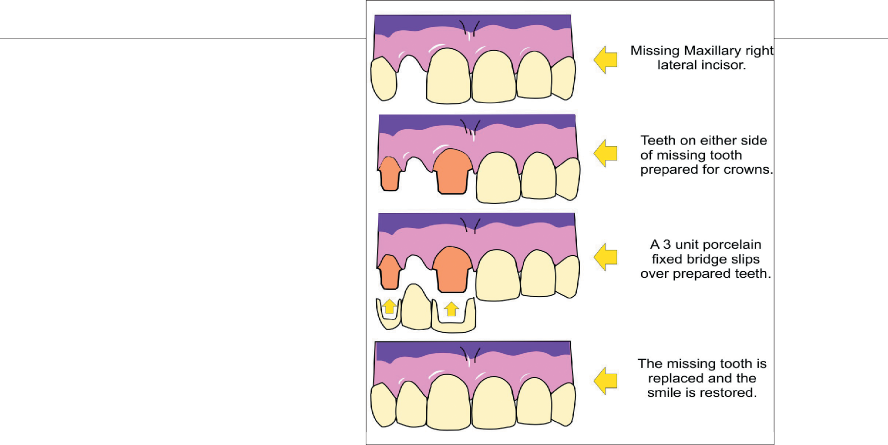
If teeth exist on either side of the space created by the lost teeth, another solution is be a fixed bridge (figure 40).
A fixed bridge consists of preparing the teeth and placing a crown on either side of the space created by the missing tooth/teeth. An impression of the prepared teeth is taken and sent to a dental lab. At the lab, a model of the mouth with the prepared teeth is made. The technician will include two crowns, one for each prepared tooth on either side of the space. A fake dummy tooth (called a pontic) is fused to the two fabricated crowns thus creating a fixed bridge. The entire fixed bridge (two crowns and pontic) is sent back to the dentist and is permanently cemented onto the two prepared teeth in the patient’s mouth. The missing tooth is now replaced.
Fixed bridges, like crowns, can be made of porcelain-fused-to-gold, porcelain-fused-to-metal, or all porcelain. The same considerations for cos- metics and the rules for strength apply as they do for crowns. (figure 41)
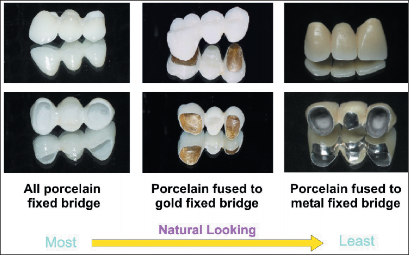
figure 40
Cosmetic Dental Procedures

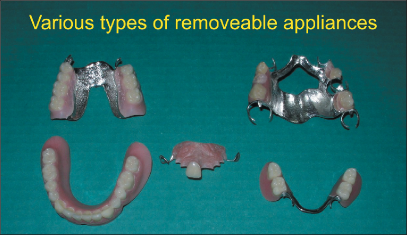
figure 42
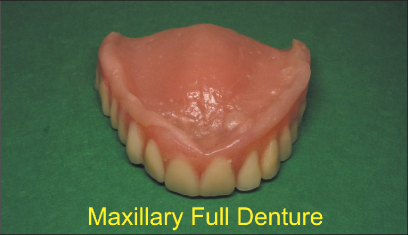
figure 42b
Sometimes many teeth or all teeth are miss- ing. Fixed bridges or implants may not be options due to lack of quality or quantity of available bone. In these cases, partial or full dentures may be the only option.
Partial dentures are used when there are a few remaining teeth available to attach to an appliance. The attachments can be made of silver looking clasps or invisible semi precision attach- ments (figure 42). The attachments stabilize the partial denture during eating.
Dentures are made when all the teeth are missing in one arch (figure 42b). Fit and comfort depends on the amount of available bone and the patient’s saliva.
Although partial dentures and full dentures provide esthetic replacement of teeth, they often lack in function and chewing efficiency. These appliances are removable. Many patients, psy- chologically, cannot bear the idea of removing their teeth nightly to clean them or to give their remaining teeth and gums a rest. Sometimes, however, the situation is such that this remains the only choice for the patient. Full dentures and partial dentures are considerably less expensive than fixed bridges and dental implants. Financial considerations are a reality and dentures are a viable alternative. Once again, the talent and experience of the cosmetic dentist will play a role in both alle- viating the concerns of the patient, and getting the best result functionally and esthetically.
CHAPTER THREE

For many patients, teeth do not always have to be replaced or restored. They just may need to be lightened and brightened in order to look better. The solution is often teeth bleaching. There are many over the counter bleaching products available that have some limited ability to whiten teeth. For the best and safest way to bleach your teeth, you should consider professionally administered tooth whitening by your cosmetic dentist.
There are two ways to professionally bleach and lighten your teeth. One method is with an in- office bleaching system that requires about an hour of your time (figure 43). Once your teeth are isolated, a strong bleaching agent is applied. Your teeth are then placed under a powerful light source that activates the bleaching agent. Your teeth will be brighter in about one hour.
A second technique for bleaching your teeth is performed by creating a thin soft custom tray that fits over your teeth. This is called a ‘bleach- ing tray’ (figure 44). A bleaching gel is placed inside the tray by the patient. It is worn in the mouth at home for a few hours each day or night. The maximum benefit from this technique will be seen in four to six weeks.
Whether an in-office bleaching technique, or an in-home bleaching tray technique is used, all teeth bleaching tends to fade over time.
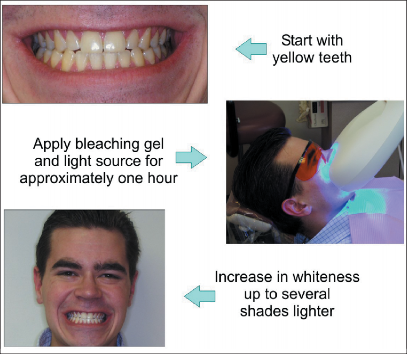
figure 43
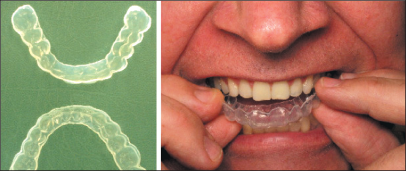
figure 44
Cosmetic Dental Procedures
figure 45
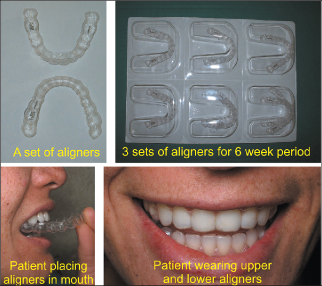
figure 46
You should use custom bleaching trays every few months at home to restore faded brightness.
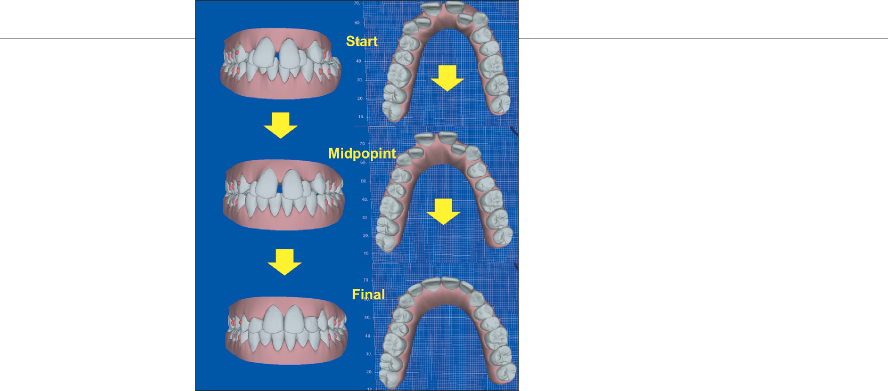
If a patient has healthy and beautiful teeth, but they just need them straightened, the best way to achieve this cosmetically is with Invisalign aligners. Invisalign® is an orthodontic treatment method using invisible or clear trays called aligners, that fit snuggly over your teeth, called aligners. The technique is simple and very accurate. To correct mal aligned teeth, an impression is taken of the teeth and sent to the Invisalign® laboratory. At the lab, the impression is scanned into a com- puter. On the computer, the software program cal- culates how to straighten the teeth, how long it will take and how to design the aligners (figure 45).
Once the aligners are fabricated they are returned to the dentist. The dentist will give the patient the aligners to wear in groups of three sets contain six individual aligners., Each aligner to be worn for two weeks (figure 46).
The aligners are worn by the patient about 20 hours per day. The patient has to return to the dentist to check the tooth movement every six weeks.
Aligners do not interfere with speech and are very comfortable to wear. They are virtually invisible. Results are often very dramatic. (fig. 47 and 47b)
CHAPTER THREE

Invisalign® tooth movement and correction can take anywhere from six months for simple cases, to 18 months or longer for more complex cases. It is truly the most conservative way to move and straighten teeth.
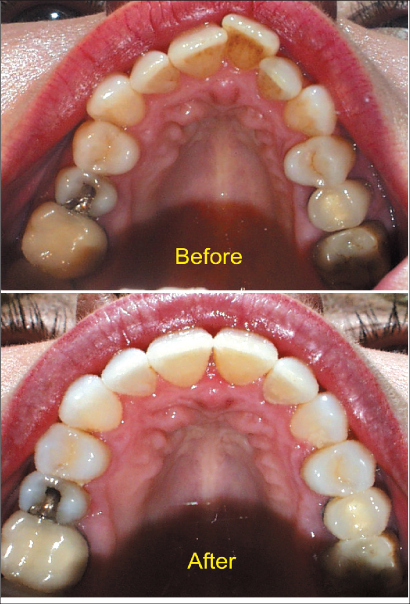
figure 47b
37

CHAPTER FOUR

S
This chapter from Amazing Smiles Through Cosmetic Dentistry explains or demonstrates cosmetic dental procedures as part of Dr. Albert J. Kurpis’s broader cosmetic dentistry approach to improving smile balance, appearance, and confidence.
The right treatment depends on the condition of the teeth, gums, bite, facial balance, smile goals, and a professional examination. Similar-looking smile problems may require different solutions.
Cosmetic dentistry is designed to improve the appearance of the teeth and smile. For many patients, a more balanced and attractive smile can also improve confidence in social, personal, and professional situations.
Use the related chapter links on this page to explore similar cosmetic dentistry cases, porcelain veneer examples, dental implant topics, bite correction cases, and full mouth reconstruction chapters.
Swipe left or right on mobile to move between book pages.